
How to Descend Faster, Safer,
and with More Confidence
What You’ll Learn
In this article, you’ll discover:
_______________________________
There’s a reason experienced cyclists often say races are won on the descents just as much as the climbs.
Descending well isn’t about being fearless. It’s about understanding your bike, trusting your skills, and making smooth, deliberate decisions. Whether you’re carving through alpine switchbacks, rolling gravel descents, or simply trying to keep up with your riding group, improving your descending technique can make every ride safer—and a lot more fun.
The good news? Descending is a learned skill. With practice and a few key techniques, you’ll gain confidence every time the road points downhill.
Your bike naturally follows your eyes.
One of the biggest mistakes riders make is staring directly in front of the front wheel or fixating on hazards like potholes, gravel, or guardrails. Instead, keep your eyes focused well ahead and look through the corner toward the exit.
This gives your brain more time to process the road ahead and naturally guides your bike along a smoother line.
Pro Tip: If you find yourself staring at the shoulder or the centerline, consciously shift your gaze to where you want the bike to go—not where you’re afraid of ending up.
The drops aren’t just for sprinting.
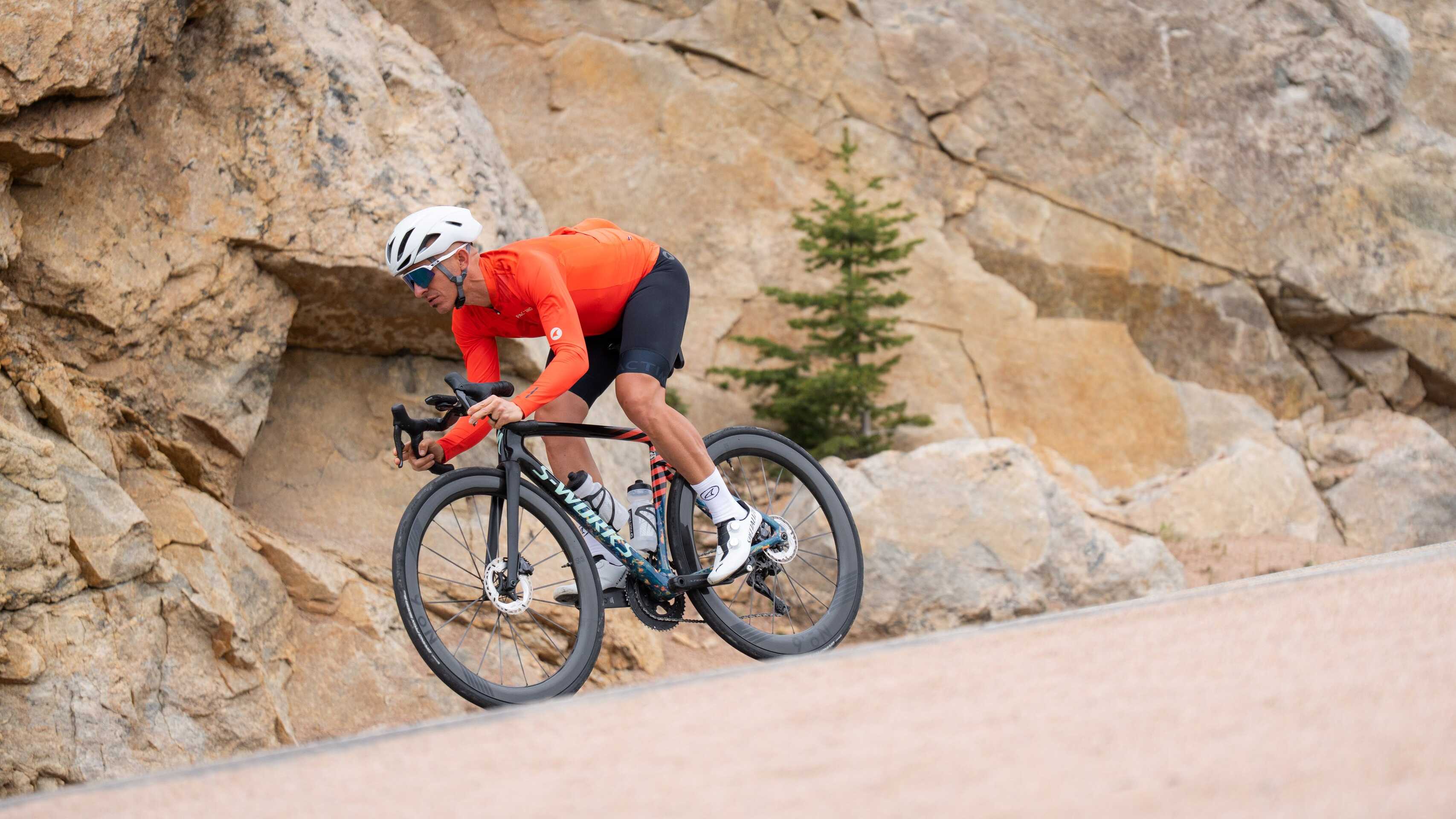
Descending from the drops lowers your center of gravity, improves stability, and gives you better leverage on the brake levers. It also distributes your weight more evenly between the front and rear wheels.
If you aren’t comfortable descending in the drops, practice on moderate hills before tackling longer mountain descents.
Tension is the enemy of good bike handling. Many riders grip the bars too tightly when they’re nervous. Unfortunately, that makes the bike harder to control.
Instead:
Your bike is designed to move beneath you. Let it absorb small bumps instead of fighting every movement.
One of the most important descending habits is learning when to brake.
Complete most of your braking before you begin turning. Braking hard while the bike is leaned over reduces available traction and increases the chance of losing grip. Enter the corner at a speed you’re comfortable with, then focus on making a smooth turn and accelerating out of it.
Modern hydraulic disc brakes provide exceptional stopping power, but even they work best when applied progressively rather than abruptly.
Professional racers spend years perfecting line choice because smoother lines require less braking and preserve momentum.
On roads that are open and clear of traffic, the ideal path through a corner generally follows an outside-inside-outside line:
Always stay within your lane and be mindful of oncoming traffic. Never sacrifice safety for speed.
Improve your cycling confidence with five essential bike handling drills. Read Master Better Bike Handling Skills with These Essential Cycling Drills
As your speed increases, proper weight distribution becomes increasingly important.
Keep your hips centered over the bike while allowing it to lean beneath you through corners. On tighter turns, apply firm pressure through your outside pedal while keeping your inside pedal raised to avoid striking the pavement.
This creates a stable platform and increases traction through the turn.
Modern road tires provide remarkable grip.
Many riders dramatically underestimate how much traction a quality tire can generate on clean, dry pavement.
Confidence grows when you understand your equipment. Running appropriate tire pressure and keeping your tires in good condition will do more for your descending confidence than almost anything else.
Fast descenders rarely look dramatic.
Instead of making sudden steering corrections, abrupt braking, or jerky body movements, strive for smoothness in everything you do. Smooth riders carry speed naturally because every movement flows into the next.
Think of descending as a series of connected motions rather than individual reactions.
Long descents become much easier when your kit disappears beneath you. Our article Why We Redesigned the Flyte Bib explains how reducing pressure points and improving stability can help you stay comfortable for hours on the bike.
Every descent is different.
Be prepared for:
Even familiar roads can change overnight.
Reduce your speed whenever visibility is limited or road conditions are uncertain.
Mountain weather changes quickly. Before tackling long alpine descents, make sure you’re dressed for the conditions with the right cycling jacket or vest.
Rain doesn’t have to end your ride. Learn eight practical wet weather cycling tips. Read How to Ride Safely in the Rain: 8 Wet Weather Cycling Tips
Confidence doesn’t come from one big descent. It comes from riding the same hill multiple times and gradually becoming more comfortable.
Choose a descent you know well. Ride it repeatedly.
Focus on one skill at a time:
Small improvements quickly become lasting habits.
Want to see these techniques put into action? Read Five Lessons from Bighorn Gravel, where technical descents, altitude, and fatigue all played a role in race-day performance.
Not every rider needs to descend like a professional racer. The goal isn’t maximum speed. The goal is maximum control. As your confidence grows, your speed will naturally increase without forcing it.
Every experienced descender started exactly where you are today.
Even experienced cyclists occasionally fall into bad habits.
Avoid these common mistakes:
Recognizing these habits is often the first step toward correcting them.
The fastest descenders aren’t necessarily the bravest. They’re the smoothest.
They brake early, stay relaxed, look ahead, and trust both their equipment and their practice.
As with every aspect of cycling, confidence comes one ride at a time. Start on familiar roads, focus on good technique rather than outright speed, and you’ll soon discover that descending becomes one of the most rewarding parts of every ride.
Generally, yes. Riding in the drops lowers your center of gravity, improves stability, and provides the best access to your brake levers.
Continue pedaling until your cadence becomes uncomfortably high. Then level your pedals and focus on maintaining a balanced, stable position.
Ideally, complete most of your braking before entering the corner. Light adjustments may sometimes be necessary, but heavy braking while leaned over reduces available traction.
Descending combines speed, cornering, and rapid decision-making. Confidence comes with experience. Practicing on familiar roads and focusing on smooth technique will gradually reduce anxiety.
In many cases, yes. Wider tires run at lower pressures, offering improved comfort, grip, and confidence on imperfect road surfaces without sacrificing much speed.